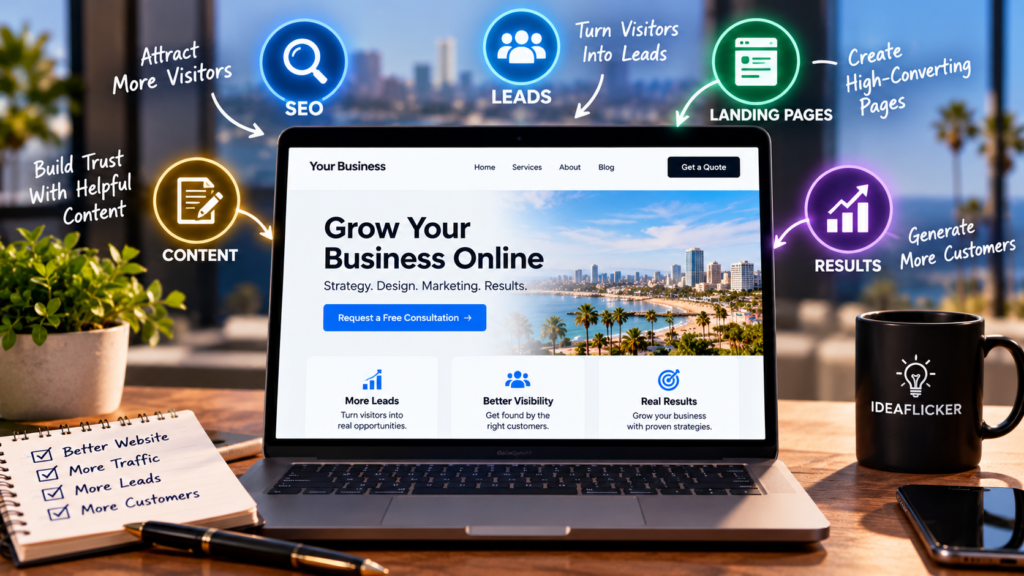
Your small business website should do more than look professional. It should help turn visitors into potential customers.
Whether you provide professional services, operate a local business, or sell products online, generating leads is an important part of growing your company. Yet many businesses invest in website design and marketing without creating a clear path for visitors to contact them.
The good news is that you can often improve lead generation by making your website easier to understand, more trustworthy, and more focused on the needs of your customers.
Here are practical strategies to help you get more leads from your small business website.
- Make Your Main Offer Clear
When someone visits your website, they should quickly understand what your business does, who you help, and why they should consider working with you.
Avoid vague headlines that sound impressive but fail to explain your services.
For example, instead of saying “Innovative Solutions for a Better Tomorrow,” a marketing agency could say “Digital Marketing Services That Help Small Businesses Reach More Customers.”
A clear headline communicates your value immediately.
Your homepage should also explain your primary services and give visitors a logical next step. If people have to search through multiple pages to understand what you offer, they may leave before contacting you.
- Use Clear Calls to Action
A call to action tells visitors what to do next.
Examples include:
Request a Free Consultation
Get a Project Quote
Schedule a Call
Contact Our Team
Request More Information
Place your primary call to action where visitors can find it easily, such as near the top of your homepage and at the end of important service sections.
Use wording that accurately reflects what happens after someone clicks. If you offer a free consultation, explain what the consultation includes. If customers can request a quote, make the process simple.
Avoid overwhelming visitors with several competing buttons. One primary action and a few relevant secondary options are usually easier to understand.
- Create Dedicated Service Pages
A single page listing every service your business offers may not provide enough information to convince potential customers to contact you.
Consider creating a dedicated page for each major service.
For example, a digital marketing agency might create separate pages for:
Search engine optimization
Website design
Social media marketing
Paid advertising
Local SEO
Each page should explain the service, the problems it solves, who it is for, and what customers can expect.
Dedicated service pages can also help your website target more specific search queries. Someone searching for website design services has a different immediate need from someone searching for local SEO.
Make it easy for visitors to contact you directly from each service page.
- Build Trust Before Asking for the Sale
Potential customers may hesitate to contact a business they don’t know. Your website should give them reasons to feel confident.
Useful trust signals include:
Genuine customer testimonials.
Relevant case studies and documented results.
Examples of previous work.
Clear business contact information.
Transparent explanations of your process.
Professional, consistent branding.
If you have completed successful projects, explain the challenge, the work performed, and the outcome. Use real results whenever possible, and never invent testimonials, clients, or performance statistics.
New businesses can build credibility by publishing useful educational content, explaining their expertise, and clearly outlining what customers can expect.
- Improve Your Website’s Mobile Experience
Many potential customers visit business websites from smartphones. If your site is difficult to navigate on a small screen, you could lose inquiries.
Check that your website:
Displays correctly on mobile devices.
Uses readable text and appropriately sized buttons.
Loads important information without unnecessary delays.
Makes phone numbers and email addresses easy to access.
Provides a simple way to complete contact forms.
Avoids intrusive pop-ups that block the content.
Test the entire process yourself on a phone. Visit your homepage, open a service page, and submit a test inquiry if possible.
A website should make contacting your business straightforward, regardless of the device a visitor uses.
- Make Contact Forms Simple
Long contact forms can discourage potential customers from completing them.
Ask only for the information you need to begin the conversation. For many businesses, a name, email address, and short description of the customer’s needs may be sufficient.
You can collect additional details later.
Make sure your form works properly, displays helpful error messages, and confirms when a submission has been received. Test that inquiries actually reach the intended inbox.
Depending on your business, providing a phone number, email address, or appointment-booking option alongside the form can give visitors another way to contact you.
- Attract the Right Visitors Through SEO
More website traffic does not automatically mean more leads. The goal is to attract people who are likely to need your services.
Search engine optimization can help your website appear for relevant searches.
Start by identifying the phrases potential customers use when looking for your services. These may include service-specific searches, location-based queries, or questions related to problems your business solves.
Create useful service pages and blog articles that directly address those needs.
For local businesses, consistent business information, a well-maintained Google Business Profile, and relevant local content can also support visibility in local search results.
SEO generally requires ongoing work, and results are not guaranteed. Focus on attracting relevant visitors rather than pursuing traffic numbers alone.
- Create Landing Pages for Marketing Campaigns
If you advertise a specific service, consider directing visitors to a dedicated landing page instead of sending everyone to your homepage.
A good landing page focuses on one primary offer and includes:
A clear headline.
A concise explanation of the benefits.
Relevant proof or trust signals.
Details about the service.
A prominent call to action.
A simple inquiry or booking process.
For example, a website design campaign should ideally lead to a page explaining your website design services, not a general homepage that requires visitors to navigate elsewhere.
The closer the landing page matches the advertisement or search that brought someone there, the easier it is for visitors to understand the offer.
- Measure Leads and Conversion Rates
You cannot reliably improve results if you don’t know how visitors interact with your website.
Track useful metrics such as:
Number of qualified inquiries.
Contact form submissions.
Phone calls generated by your website.
Landing-page conversion rates.
Traffic sources that produce leads.
Cost per lead for paid campaigns.
A conversion rate measures the percentage of visitors who complete a desired action.
For example, if 500 people visit a landing page and 15 submit inquiries, the inquiry conversion rate is 3%.
This is a simple illustration, not a recommended benchmark. Appropriate conversion rates vary by industry, traffic source, offer, and customer intent.
Use analytics and conversion tracking to identify which pages and campaigns generate meaningful business opportunities.
- Follow Up With Potential Customers
Generating an inquiry is only the beginning. Your response process can affect whether a lead becomes a customer.
Create a simple process for acknowledging inquiries, responding to questions, and arranging follow-up conversations.
Make sure someone is responsible for checking submissions and responding within a reasonable timeframe.
You can also use a customer relationship management system to organize leads, track conversations, and manage follow-up tasks as your business grows.
Collect and use customer information responsibly, and make sure your follow-up practices comply with applicable privacy and marketing requirements.
Final Thoughts
A small business website can become a more effective lead-generation tool when it communicates a clear offer, builds trust, attracts relevant visitors, and makes contacting your business easy.
You don’t necessarily need a complete redesign to get started. Improving your headlines, service pages, contact forms, calls to action, and conversion tracking can help you identify opportunities for better results.
At IdeaFlicker, we help businesses strengthen their online presence through digital marketing strategies and website improvements. If your website attracts visitors but struggles to generate inquiries, improving its messaging, visibility, and user experience is a practical place to start.