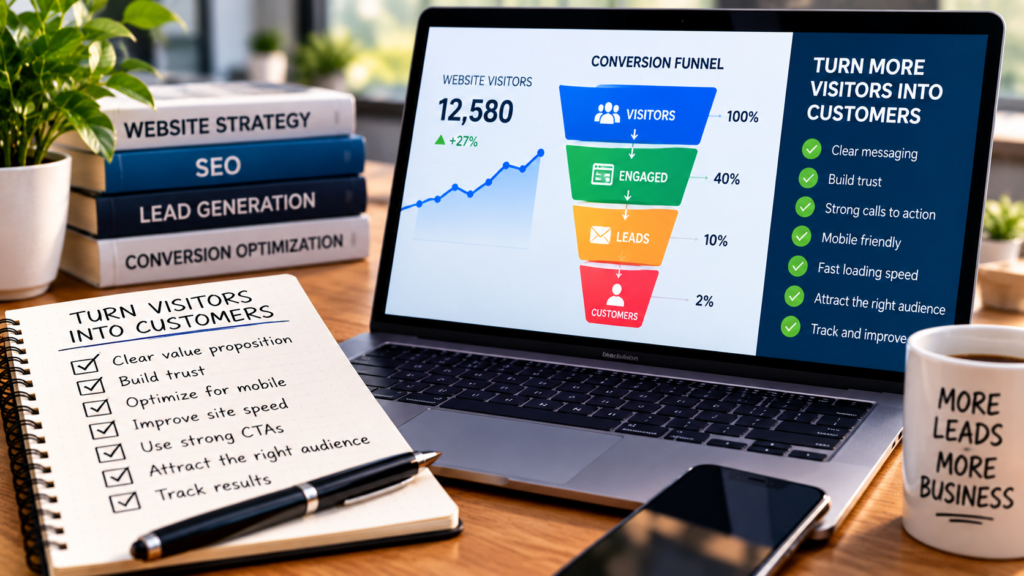
Getting people to visit your website is only half the battle. If visitors aren’t calling, submitting contact forms, booking appointments, or making purchases, your website may not be doing enough to turn attention into business.
For small businesses, improving website conversions can be more valuable than constantly spending money to attract additional traffic. Here are seven common reasons your website visitors aren’t becoming customers and what you can do about it.
- Your Website Doesn’t Clearly Explain What You Offer
Visitors should understand what your business does within seconds of landing on your website.
If your homepage uses vague headlines, confusing language, or generic statements about quality and customer service, potential customers may struggle to understand why they should choose you.
Instead, communicate three things clearly:
What your business offers.
Who your services are designed for.
What problem you help customers solve.
For example, a headline such as “Affordable Website Design for Local Businesses” communicates a more specific benefit than “Welcome to Our Company.”
Clear messaging helps visitors determine whether your business meets their needs without making them search through multiple pages.
- Your Website Doesn’t Build Enough Trust
People are less likely to contact a business if they aren’t confident it will deliver what it promises.
Trust becomes especially important when customers are comparing unfamiliar companies or considering an expensive purchase.
Make your website more credible by including genuine customer reviews, testimonials, relevant experience, examples of completed work, and clear business contact information.
If you have case studies or measurable results from previous projects, share them honestly. Specific evidence is generally more persuasive than broad claims about being the best in your industry.
Avoid fake testimonials, exaggerated promises, and unsupported guarantees. These can damage your reputation rather than improve conversions.
- Visitors Don’t Know What to Do Next
A visitor might like your services but leave because the next step isn’t obvious.
Every important page should guide people toward an appropriate action. Depending on your business, that could mean requesting a quote, scheduling a consultation, calling your office, or purchasing a product.
Use clear calls to action such as:
Request a Free Quote
Schedule a Consultation
View Our Services
Contact Our Team
Place these actions where visitors naturally need them, rather than hiding them at the bottom of a long page.
Make the process straightforward. If someone wants to contact you, don’t force them to navigate several pages to find a phone number or contact form.
- Your Website Is Difficult to Use on Mobile
Many potential customers browse websites on their phones. If your site is difficult to navigate on a small screen, you could lose business before visitors even consider your services.
Check your website on an actual smartphone. Look for text that’s difficult to read, buttons that are too small, menus that don’t work properly, and forms that require excessive typing.
Also check whether important information, such as pricing, service descriptions, and contact details, is easy to find.
A mobile-friendly website should make it simple for someone to understand your offer and take action without constantly zooming in or struggling with the layout.
- Your Website Loads Too Slowly
Slow websites create unnecessary friction. Visitors may leave before your content finishes loading, particularly when they’re browsing on a mobile connection.
Large images, excessive scripts, unnecessary plugins, and poorly optimized website code can contribute to slow performance.
Start by testing your website with Google’s PageSpeed Insights tool. Review the recommendations and prioritize the issues that have the greatest effect on loading speed and usability.
You don’t necessarily need a complete redesign to improve performance. Optimizing images, reducing unnecessary scripts, and improving hosting can make a meaningful difference.
- Your Website Attracts the Wrong Visitors
Not every website visitor is a potential customer.
For example, a business selling premium marketing services may attract substantial traffic from people searching for free marketing templates. Those visitors might read an article but have little intention of purchasing professional services.
Review the search terms, advertising campaigns, referral sources, and landing pages bringing people to your website.
Ask whether the visitors you’re attracting are likely to need what you sell.
If your traffic doesn’t match your target audience, refine your search engine optimization strategy, advertising keywords, and website content to attract people with more relevant needs and stronger purchase intent.
More traffic isn’t automatically better. The goal is to attract the right people.
- You Aren’t Measuring What Happens After Visitors Arrive
Without conversion tracking, it’s difficult to know why your website isn’t generating more business.
You might know how many people visit your website but have no clear picture of how many contact you, request quotes, or complete purchases.
Set up appropriate analytics and conversion tracking to measure meaningful actions.
For a service business, useful metrics might include contact form submissions, phone calls, consultation bookings, and qualified leads. For an online store, you might track purchases, checkout completion, and revenue.
Google Analytics 4 and Google Search Console can provide useful information when configured correctly. Call tracking or a customer relationship management system may also help, depending on your business.
Review the data regularly to identify where potential customers drop off and which pages produce the strongest results.
How to Improve Your Website Conversion Rate
You don’t have to fix every problem at once.
Start by identifying the biggest obstacle preventing visitors from becoming customers. If your offer is confusing, improve your messaging. If visitors aren’t contacting you, make your calls to action more prominent. If your website attracts irrelevant traffic, refine your marketing strategy.
Make one meaningful improvement at a time and measure the results.
For example, you could test a clearer homepage headline, simplify your contact form, or add genuine customer testimonials to an important service page. Compare performance before and after the change while accounting for differences in traffic and other factors.
Over time, these improvements can help you get more value from the visitors you’re already attracting.
Final Thoughts
Website traffic alone doesn’t guarantee business growth. Your website needs to communicate value, build trust, attract relevant visitors, and make it easy for people to take the next step.
Before spending more money on advertising or trying to increase traffic, evaluate whether your existing website is turning visitors into meaningful business opportunities.
Need help improving your website and digital marketing? IdeaFlicker helps small businesses strengthen their online presence, attract relevant customers, and improve their marketing strategy. Visit IdeaFlicker.io to explore ways to grow your business online.